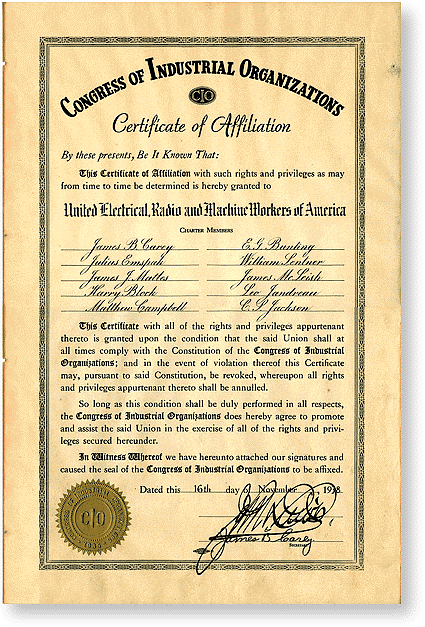
The union began as a coalition of autonomous local unions and militant workers’ committees based in electrical manufacturing and radio assembly plants. When their request for a charter as a union for the unorganized electrical manufacturing industry was rejected by the American Federation of Labor, shop leaders chose to go it alone, launching their new national union in March 1936. UE became the first union chartered by the newly-established Congress of Industrial Organizations (CIO).
UE grew rapidly, bringing better conditions and rights on the job to workers employed by industrial giants like General Electric, Westinghouse and RCA, as well as many other electrical manufacturing and machine companies. By the end of World War II, UE was the third largest CIO union, with a membership of 500,000.
Following the war, disagreements with the CIO leadership over the direction of the labor movement led to UE’s withdrawal from the CIO in 1949; within months, a CIO convention “expelled” UE and, eventually, 10 other militant unions with a total membership of one million workers. The CIO joined big business, the press and politicians in smearing UE as “communist-dominated” and the CIO chartered a new union (IUE) to take the union’s place.
UE came under ferocious attack as the anti-communist hysteria intensified in the early 1950s. Attempts were made to officially brand the union as a “subversive organization” and to deport UE leader James Matles. UE shop leaders were fired and blacklisted, even jailed. Politicians, big business and the CIO worked closely together to destabilize UE; the union lost more than half its members.
Steady organizing rebuilt the union in the 1960s and 1970s, but heavy losses followed in the 1980s due to mass layoffs and plant closings. Too often, profitable plants were closed by corporate giants eager for the super-profits to be gained through super-exploitation abroad. UE led the labor movement in resistance to plant closings and attempts by employers to wring concessions from unions by use of the plant-closing threat.
UE enjoyed real growth in the 1990s as a result of aggressive organizing, and many independent unions affiliated with UE. The affiliation of independent public-sector unions paved the way for a dramatic diversification of the union membership by economic sector and job, and UE now represents a wide variety of state, county, municipal and school workers across the country. We also represent graduate workers at universities in multiple states and workers at private social service agencies and healthcare facilities.
UE returned to organizing in the South with the 1999 affiliation of the North Carolina Public Sector Workers Union, now UE Local 150, and for over two decades has organized public-sector workers in North Carolina, Virginia and West Virginia who are denied the right to collective bargaining.
Workers at two food co-ops in Vermont organized with UE in 2003; food co-op workers in Pittsburgh and Madison, Wisconsin joined UE in 2015 and 2019 respectively. In 2008, federal contract workers in Vermont and California joined UE, and they have since been joined by federal contract workers in Chicago, Nebraska, New Hampshire, and Kentucky.
In December 2008, members of UE Local 1110 in Chicago made history by occupying their workplace, Republic Windows and Doors. Their militancy and unwillingness to simply accept the closure of their factory captured the imagination of a nation reeling from financial collapse, won an endorsement of their cause from the president-elect, and forced one of the nation’s most powerful banks to come to the table and negotiate. UE members won a $1.75 million settlement — and eventually, a reopening of their factory.
Since 2011, UE has aggressively organized rail crew drivers who work for contractors hired by the railroads, starting with a group of drivers in the greater Chicago area. UE now has a national collective bargaining agreement with rail crew contractor Hallcon, covering over 2,000 drivers in 16 states who are members of six UE locals.